Someone fills in the contact form on your website. How long until they hear back from you? If you’re like most business owners, you don’t know the exact answer. You probably think it’s “pretty quick”. In practice, it’s often hours, and sometimes the next day.
This guide answers a simple question: how fast should a business reply to a new lead? You’ll get a clear target, the reasons behind it, a way to measure your own response time in ten minutes, and practical ways to get faster without hiring more staff.
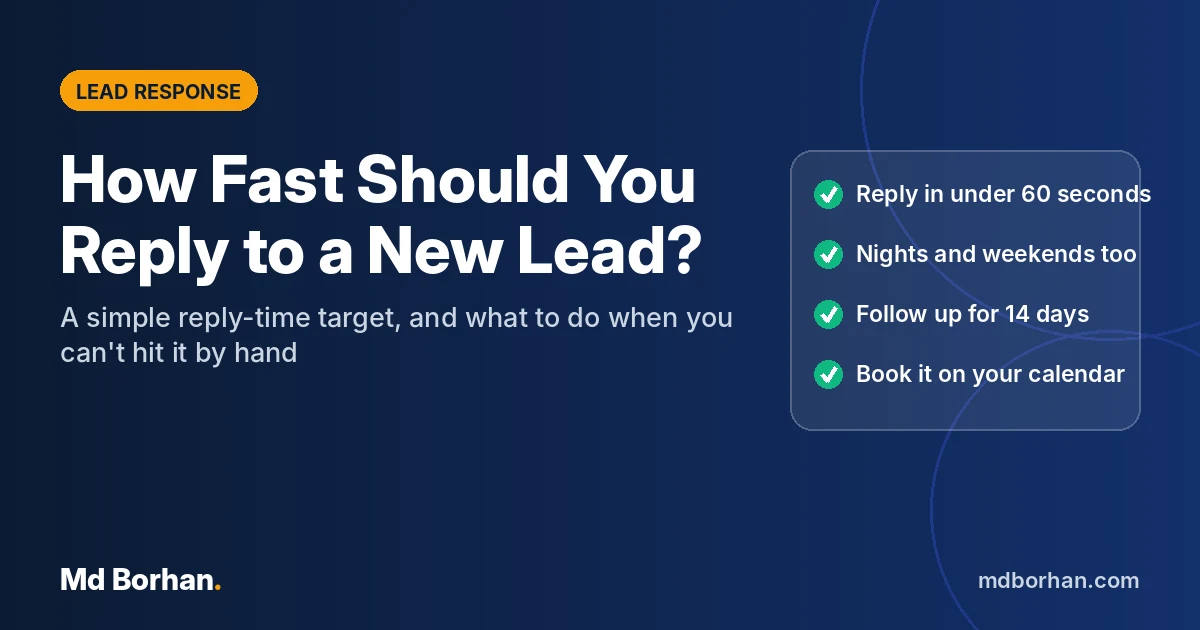
The short answer: within 5 minutes, and ideally under 60 seconds
If you want one number to aim for, make it 5 minutes. If you can reply in under a minute, even better. That doesn’t mean you need to close the deal in a minute. It means the person who just reached out should get a real, helpful reply while they’re still thinking about you.
Why so fast? Because the moment someone contacts a business is the moment they’re most interested. A few minutes later they’re back on Google, filling in the next form or calling the next number on the list.
Why speed matters so much
1. People contact more than one business
When someone needs a dentist, a lawyer, a repair shop or a cleaner, they rarely contact just one. They send two or three enquiries and go with whoever responds first and makes the next step easy. If you reply second, you’re often competing with a business that has already booked the appointment.
2. Interest fades fast
An often-cited Harvard Business Review study on online sales leads found that companies that contacted leads within an hour were nearly seven times as likely to qualify them as companies that waited even one hour longer, and more than 60 times as likely as companies that waited 24 hours or more. That research looked at B2B companies, but the pattern is easy to recognise in any business: the longer a lead waits, the colder it gets.
3. A fast reply is a trust signal
A quick, personal reply tells the customer something before they’ve even met you: this business is organised and they’ll look after me. A slow reply tells them the opposite.
What a “reply” actually needs to include
Speed isn’t the only thing that matters. “Thanks, we’ll be in touch” is fast, but it doesn’t move anything forward. A good first reply does three things:
- Uses their name and refers to what they asked about, so it doesn’t feel like a robot.
- Asks one or two useful questions, such as what they need, when, and where.
- Offers a clear next step, usually a link to book a time or a promise of a call at a specific time.
Here’s a simple example: “Hi Sarah, thanks for getting in touch about a new-patient check-up. Are you looking for something this week or next? You can also pick a time here: [booking link].”
How to measure your own response time in 10 minutes
You can’t improve what you don’t measure. Here’s a quick test you can run today:
- Submit your own website form using a personal email address your team won’t recognise. Note the time.
- Call your main number at a busy time, like lunchtime or late afternoon, and don’t leave a voicemail. Note whether anyone calls or texts you back, and when.
- Send an enquiry after hours, for example at 9pm, and see when the reply arrives.
- Write down the three times. That’s your real response time, not the one you’d guess.
Most owners who do this are surprised. If any of your three results is over an hour, you’re almost certainly losing customers to faster competitors. To see roughly what that costs, put your numbers into the free Lead Leak Calculator.
Why most businesses are slow (and it’s not laziness)
Slow replies are rarely about effort. They come from how small businesses actually work:
- The people who answer are busy doing the work. A dental receptionist is checking patients in. A technician is out on a job. A lawyer is in court.
- Leads arrive at bad times. Evenings, weekends and lunch breaks are exactly when people have time to look for help.
- Leads come from too many places. Website forms, ad forms, phone calls and emails all land in different inboxes.
- Nobody owns follow-up. Everyone assumes someone else replied.
That’s why “we’ll just try harder” rarely works for long. The fix is a system, not more willpower.
How to get faster without hiring
Step 1: Put every lead in one place
Route website forms, ad leads and missed calls into a single list, ideally a CRM. If you can’t see all your leads in one place, you can’t reply to them quickly.
Step 2: Send an instant first reply automatically
The first reply doesn’t need a person. It needs to be fast, friendly and useful. An automated text and email that goes out within seconds, uses the person’s name and offers a booking link covers most of what a good receptionist would say in the first minute.
Step 3: Text back missed calls
When a call goes unanswered, send an automatic text from the same number: “Sorry we missed your call, how can we help?” Many people prefer to reply by text anyway. Read more in Missed call text back: what it is and how to set it up.
Step 4: Follow up when people go quiet
Plenty of leads don’t reply to the first message, not because they’re not interested, but because they got busy. A short sequence of two or three friendly follow-ups over the next couple of weeks wins back a meaningful share of them.
Step 5: Let people book without a phone call
Every phone call needed to book an appointment is a chance for the lead to drop off. A booking link with real availability removes that step.
Does fast reply look different by industry?
The principle is the same everywhere, but the details change:
- Dental and med spa: new-patient enquiries often come during busy front-desk hours. See how it works for practices.
- Law firms: people facing legal problems often contact several firms at once and want reassurance fast. See how it works for law firms.
- Home services: emergencies don’t wait, and the crew is usually on another job. See how it works for home services.
- Cleaning companies: quote requests are usually sent to several companies at the same time. See how it works for cleaners.
See what a 60-second reply feels like
The easiest way to understand the difference is to experience it as a customer. Try the 60-second live demo: fill in the form, start the timer, and see how quickly a real reply arrives on your phone.
Summary
- Aim to reply to every new lead within 5 minutes, and under a minute if you can.
- A good first reply uses their name, asks one useful question and offers a next step.
- Measure your real response time with your own form, phone and after-hours test.
- Fix it with a system: one lead list, instant automated replies, missed-call text-back, follow-up and self-booking.
Free: The 5-Minute Lead Response Scorecard
A one-page self-check you can run on your own business today. Ten yes/no questions that show exactly where leads are slipping through.
Related reading: AI appointment booking: what it can and can’t do yet.