A missed HVAC call can happen for completely normal reasons.
Your technician is inside a customer’s home. Your dispatcher is already on another call. Your office team is handling multiple requests. Or a homeowner reaches out after business hours.
The problem is not that your team missed one call.
The bigger problem is what happens after the call is missed.
Does the customer receive a quick response?
Does anyone find out why they called?
Is the request urgent?
Does the lead reach the right person?
Does anyone follow up?
And most importantly:
Does that opportunity ever reach a booked appointment?
That is where HVAC missed call recovery becomes valuable.
I’m Md Borhan, an Automation Strategist & Digital Marketing Professional focused on building practical AI-powered lead conversion and missed-lead recovery systems for HVAC companies.
My philosophy is simple:
Automation should support your team, not replace the human touch.
What Is HVAC Missed Call Recovery?
HVAC missed call recovery is a process that gives an unanswered caller a clear next step instead of allowing the opportunity to disappear into voicemail.
A basic recovery workflow can look like this:
Missed Call → Fast Response → Qualification → Human Handoff → Appointment
The technology behind that process can vary.
The goal does not.
The goal is to keep the customer conversation moving until the appropriate person on your team can take over.
A useful recovery workflow may:
- acknowledge the missed call
- ask what service the customer needs
- identify urgency
- confirm the service area
- collect useful context
- route the opportunity to the right person
- help move qualified leads toward booking
- trigger respectful follow-up when needed
This is closely aligned with the lead-conversion system on my HVAC automation services page, where the workflow is built around faster response, qualification, follow-up and cleaner handoffs.
Why Missed Calls Can Become Lost HVAC Opportunities
HVAC is different from many industries because customers often contact a company when they already have a problem.
Their AC may not be working.
Their heating system may have failed.
They may need emergency service.
They may be comparing contractors before making a decision.
In that situation, the customer is not necessarily going to wait patiently for one company to return a call.
They may simply call another HVAC contractor.
Your team did not intentionally lose the opportunity.
The process simply did not have a strong second step.
That distinction matters.
Because the solution is not always:
“Generate more leads.”
Sometimes the better question is:
“What are we currently doing with the leads we already receive?”
My website is built around this exact idea: missed calls, slow response, after-hours inquiries, weak qualification, inconsistent follow-up, and messy handoffs are all potential points where an otherwise valuable opportunity can stall.
The Real Problem Happens After the Phone Stops Ringing
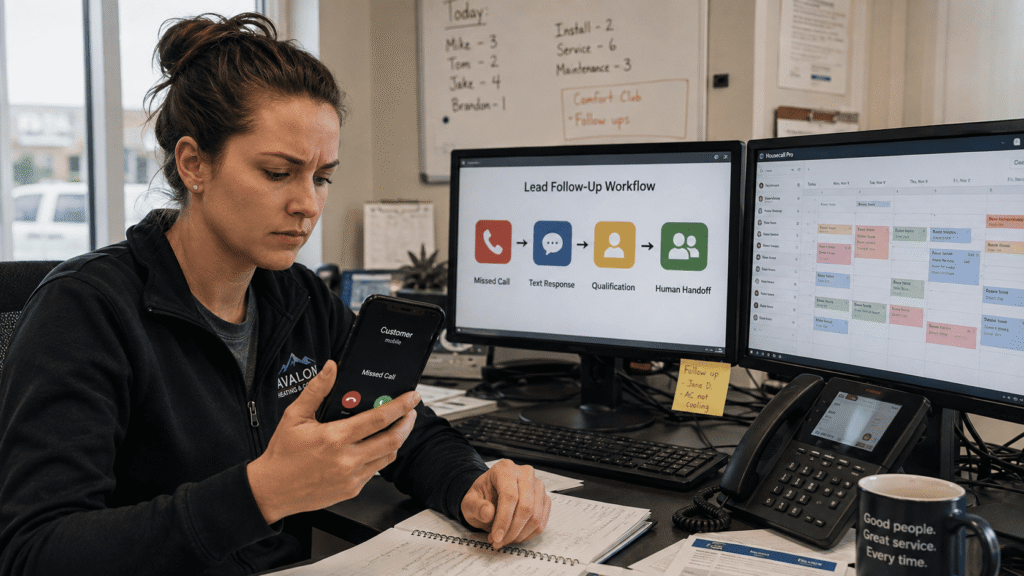
Let’s look at two different customer journeys.
Traditional missed-call process
Customer calls
↓
Nobody answers
↓
Voicemail
↓
Office notices later
↓
Callback
↓
Customer may answer
↓
Or the customer may already have booked elsewhere
Now compare that with a structured recovery process.
HVAC missed call recovery process
Customer calls
↓
Call is missed
↓
Immediate acknowledgement
↓
Customer shares service need
↓
Basic qualification
↓
Human team receives context
↓
Appointment or next step
The second process does not guarantee that every caller will become a customer.
Nothing should.
But it gives the opportunity a much clearer path forward.
That is the difference between having a phone system and having a lead-recovery system.
1. Respond Quickly While Customer Intent Is High
The first job of missed-call recovery is not to sell.
It is to acknowledge.
A simple, natural response can tell the customer:
“We saw your call, and we’re here to help.”
For example:
Sorry we missed your call. What can we help you with today?
That’s enough to reopen the conversation.
From there, the workflow can ask a relevant question based on the type of HVAC business.
For example:
Is this for AC repair, maintenance, installation, or another service?
The exact message should be customized to the company.
There is no reason to make every HVAC customer go through a long automated questionnaire.
The first response should be simple.
Acknowledge → Ask → Route
2. Recover the Context Behind the Call
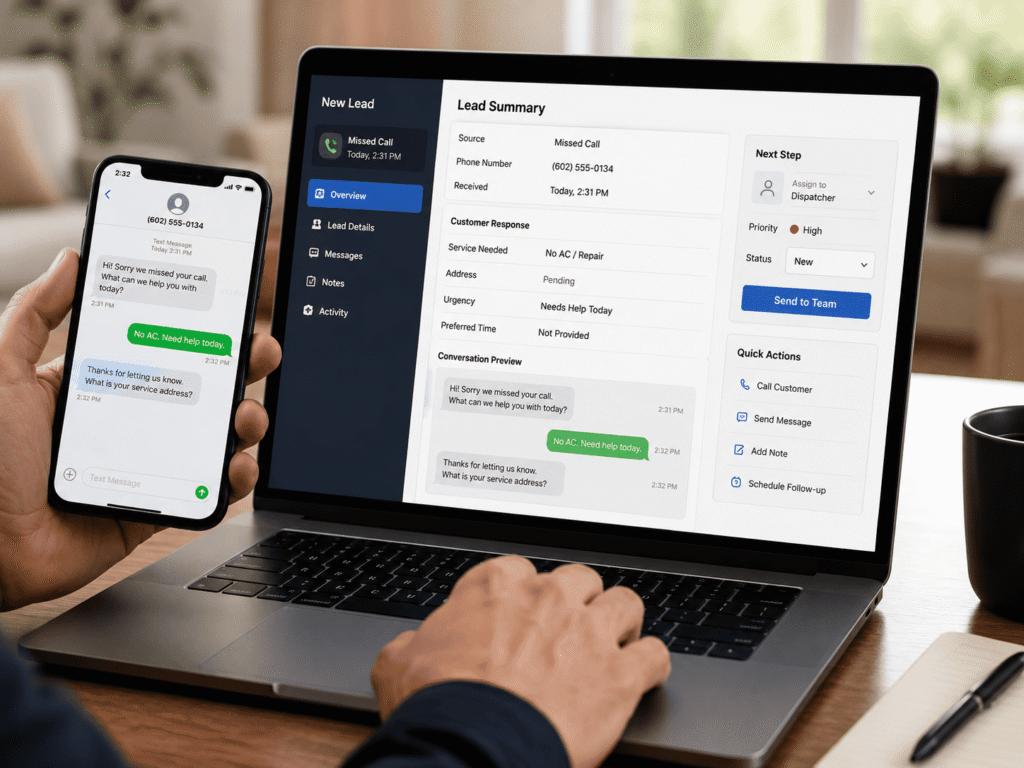
A missed call contains very little information by itself.
Your team may know:
- the phone number
- the time of the call
- perhaps a voicemail
But they may not know why the customer called.
A recovery workflow can help collect context such as:
Service needed
Repair, maintenance, installation, replacement or estimate.
Location
Is the customer inside the service area?
Urgency
Is the customer looking for immediate help or scheduling something routine?
Preferred timing
When would the customer like to speak with the team or receive service?
This context can be passed to the human team so they are not starting the conversation from zero.
Your current site describes the same philosophy: collect the service need, urgency, location and useful context before the next step.
3. Use Automation to Support Qualification
One mistake I see in AI automation discussions is trying to automate every part of the customer conversation.
That is usually unnecessary.
For HVAC businesses, qualification can remain simple.
For example:
What service do you need?
What is the address or ZIP code?
Is the issue urgent?
When would you prefer service?
That may be enough to determine the next step.
The purpose is not to create an “AI salesperson.”
It is to reduce the amount of repetitive information your human team has to collect manually.
And when a situation requires judgment, the workflow should hand it to the right person.
4. Missed-Call Recovery Should Know When to Stop
This is one of the most important principles in good automation.
The system should know when to hand control back to a human.
Imagine a customer says:
“There is a strong burning smell coming from the unit.”
That should not become a long automated conversation.
It should become a signal for human attention according to the HVAC company’s own safety and escalation procedures.
The same applies to:
- unusual technical questions
- angry customers
- pricing disputes
- complex commercial requests
- emergency situations
- anything outside the workflow rules
Automation can organize information.
Humans make the judgment calls.
That is why my approach is intentionally human-centered rather than “replace the office with AI.”
Your website states the same principle directly: the purpose is to support the existing team with faster response, better qualification and cleaner handoffs—not replace the people running the business.
5. Build an After-Hours Recovery Process
One of the clearest use cases for HVAC missed call recovery is after hours.
A customer does not stop having an HVAC problem because the office closed.
Calls and website inquiries can arrive:
- at night
- early in the morning
- during weekends
- during holidays
- while the entire team is already on jobs
A well-designed after-hours workflow can acknowledge the customer, collect basic information, and create an appropriate next step.
For example:
After-hours inquiry
↓
Acknowledgement
↓
Service type
↓
Service area
↓
Urgency
↓
Defined human handoff or next step
The exact process depends on the business’s staffing, service commitments and escalation policies.
The important thing is that the customer is not left without direction.
Your current website already presents after-hours inquiries as one of the core moments where HVAC leads can cool off before anyone gets a second chance.
6. Follow Up Without Becoming Pushy
Not every caller will answer the first follow-up message.
Some people are working.
Some are driving.
Some need to compare options.
Some simply forget.
That is why a good system needs a follow-up rule.
It does not need to send ten messages.
It needs a clear, respectful process.
For example:
Initial response
↓
Customer does not respond
↓
One appropriate follow-up
↓
Human review if needed
The purpose is consistency.
Without a process, follow-up often depends on memory.
And memory becomes unreliable when an HVAC office is busy.
My website uses the same principle for estimate follow-up: structured reminders can create consistency without sounding aggressive or robotic.
7. Send Your Team a Useful Lead Summary
Here’s a small example of how automation can improve an HVAC office workflow.
Instead of:
“Missed call from 555-0198.”
Imagine the team receives:
Missed HVAC call
Residential
No cooling
Customer is inside service area
Wants service today
Human follow-up needed
The second message is much more useful.
Your technician, dispatcher, or office manager can understand the situation faster.
This is what I mean by practical automation.
The objective is not to create a complicated dashboard just because technology makes it possible.
The objective is to give the team the information they actually need.
How HVAC Missed Call Recovery Fits Into Lead Conversion
Missed-call recovery should not exist as an isolated tool.
It should fit into the wider lead journey.
A better HVAC workflow looks like:
Lead Generation
↓
Phone Call / Website Form / Ad Lead
↓
Fast Response
↓
Lead Qualification
↓
Follow-Up
↓
Human Handoff
↓
Appointment
↓
CRM Tracking
Your How It Works page explains this same five-stage approach: map the existing lead flow, identify the leaks, design the workflow, build and connect it, then refine it as the process develops.
This is why I do not recommend dropping a generic AI bot into an HVAC business and hoping it solves everything.
The workflow comes first.
The technology comes second.
Do You Need a Full AI Receptionist?
Not necessarily.
This is where a lot of automation marketing becomes unnecessarily complicated.
If your real problem is:
“We miss calls when technicians and office staff are busy.”
Then the first solution might simply be:
Missed Call → Text Back → Basic Qualification → Human Handoff
You may not need an enormous AI phone system.
You may not need to replace your current CRM.
You may not need ten new software subscriptions.
Start with the leak.
Then solve the leak.
This is consistent with my approach: the first step is understanding how leads already arrive and how your team already works before deciding what technology belongs in the workflow.
How I Build HVAC Missed Call Recovery Systems
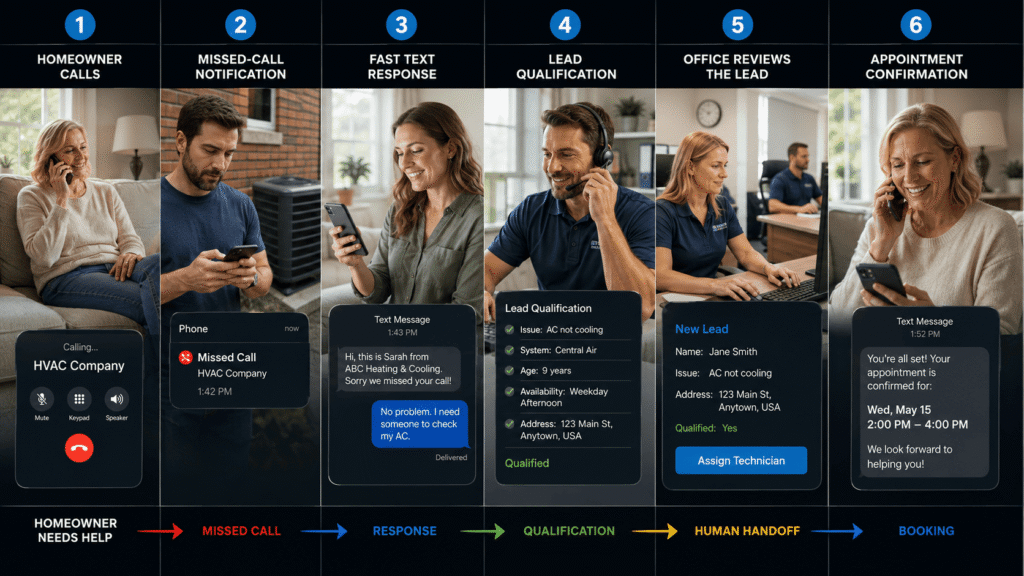
I’m Md Borhan, and my approach starts with the business process rather than the software.
I begin by asking:
Where are your leads coming from?
Phone?
Website?
Google Ads?
Meta Ads?
Referrals?
What happens when nobody answers?
Voicemail?
Callback?
Nothing?
Who owns the next step?
Office staff?
Dispatcher?
Salesperson?
Technician?
What information does the team need?
Service type?
Urgency?
Location?
Preferred time?
Where does the lead go?
CRM?
Calendar?
Spreadsheet?
Inbox?
What happens if the customer does not book?
Is there a follow-up process?
These questions help reveal the real bottleneck.
Then I design the workflow around it.
My current website describes this approach as:
Map the flow → Find the leaks → Design the workflow → Build and connect → Refine
That is the framework I use because automation should be built around the company’s existing operation, not forced into a generic template.
What My HVAC Automation Service Can Help With
Depending on the business, the system can be designed around:
Missed-call recovery
Keep unanswered calls from becoming invisible opportunities.
Fast lead response
Acknowledge new inquiries while customer intent is still active.
Lead qualification
Capture the basic information needed for the next human step.
Automated follow-up
Create consistency around prospects who are not ready to book immediately.
Appointment booking
Help qualified opportunities move toward the appropriate scheduling process.
CRM visibility
Give the team a clearer picture of what happened to each lead.
Human handoff
Route complex or judgment-heavy situations to the right person.
These are not hypothetical services invented for this article. They match the core service architecture currently presented on my website.
Who Is a Good Fit for HVAC Missed Call Recovery?
You may be a strong candidate if your HVAC company:
- receives regular inbound calls
- misses calls during busy service periods
- has technicians working in the field
- receives after-hours inquiries
- spends money on lead generation
- has website or ad-driven inquiries
- struggles with consistent follow-up
- already uses a CRM but has workflow gaps
- wants better response without replacing its team
You may be less suited to a complex automation project if your company currently receives very few leads.
Automation works best when it solves an identifiable operational problem.
That is why I recommend starting with an audit rather than immediately buying software.
How to Measure HVAC Missed Call Recovery
A workflow is only useful if you can understand whether it is improving the process.
Start with a few simple measures:
Missed calls
How many calls are unanswered?
Response time
How quickly does the first follow-up happen?
Customer replies
How many missed callers respond?
Qualified opportunities
How many recovered conversations become legitimate opportunities?
Appointments
How many move toward booking?
Human follow-up
How many require direct staff intervention?
Booked jobs
How many recovered opportunities eventually become jobs?
These metrics help you identify where the workflow works and where it needs improvement.
And they keep the conversation focused on business performance rather than on how impressive the automation software looks.
The Question Every HVAC Owner Should Ask Before Buying More Leads
Before increasing your advertising budget, ask:
“What happens to the leads we already have?”
If you receive calls but miss some of them, that matters.
If website inquiries arrive after hours, that matters.
If estimates are sent but follow-up is inconsistent, that matters.
If your CRM contains old opportunities that nobody is systematically working, that matters.
The answer may not be another lead-generation campaign.
It may be a better system between first contact and booked appointment.
That is the space where I work.
Why I Focus on Fewer Leaks, Not Just More Leads
I’m not interested in telling an HVAC owner that AI will magically transform the business.
That is not a useful promise.
Instead, I focus on practical questions:
Where are leads getting stuck?
What can be responded to faster?
What can be qualified automatically?
Where should humans take over?
Which follow-ups can be made more consistent?
How can the business get clearer visibility into the lead journey?
My goal is to make the process more dependable while keeping the human team at the center.
As I explain on my About page, my work combines digital growth experience with hands-on web automation and technical development, with a focus on helping HVAC teams lose fewer opportunities between inquiry and booking.
Start With a Free HVAC Lead Audit
You do not need to rebuild your entire marketing system to improve lead conversion.
Start with one question:
What happens when your next HVAC call is missed?
If the answer is unclear, there may be an opportunity to improve the process.
My Free Lead Audit is designed to look for practical gaps across:
- response
- missed calls
- qualification
- follow-up
- booking handoffs
You can also explore the HVAC automation services or see how the lead-conversion workflow works before deciding whether a conversation makes sense.
There is no need to force a tool onto a business that does not need it.
Understand the leak first.
Then decide what should be automated.
Final Thought
Your HVAC team will get busy.
Calls will be missed.
Technicians will be on jobs.
Dispatchers will be occupied.
Customers will reach out after hours.
That is normal.
The real question is whether the missed call becomes a dead end—or the beginning of a recovery process.
A practical workflow can create a clearer path:
Missed Call
↓
Fast Response
↓
Qualification
↓
Human Handoff
↓
Appointment
That is the opportunity behind HVAC missed call recovery.
I’m Md Borhan, an Automation Strategist & Digital Marketing Professional focused on AI-powered lead conversion and missed-lead recovery for HVAC companies.
You may not need more leads.
You may need fewer leaks.
Request a Free Lead Audit and find out where your current lead journey may be losing opportunities.
About the Author
Md Borhan is an Automation Strategist & Digital Marketing Professional focused on AI-powered lead conversion and missed-lead recovery systems for HVAC companies.
He combines digital growth experience with hands-on web automation and technical development to build practical workflows around response, qualification, follow-up, and booking.