Getting more HVAC leads is only part of the growth equation.
The harder question is what happens after a homeowner calls, submits a form, clicks an ad, or requests an estimate.
Does someone respond quickly?
What happens when the call is missed?
Who follows up after an estimate?
What happens to a lead that comes in after hours?
And how easily can your team see which opportunities are ready to book?
For many HVAC companies, the problem is not simply lead generation. It is lead management.
That is the gap I focus on solving.
I’m Md Borhan, an automation strategist and digital marketing professional who builds practical AI-powered lead conversion and missed-lead recovery systems for HVAC companies. My goal is not to replace your team with robots. It is to make the journey from new inquiry to qualified opportunity to booked appointment more consistent.
What Is HVAC Lead Management?
HVAC lead management is the process of capturing, responding to, qualifying, following up with, tracking, and moving potential customers toward the next appropriate step.
A lead might come from:
- Phone calls
- Google Ads
- Facebook or Instagram
- Your website
- Organic search
- Referrals
- Existing customers
- After-hours inquiries
A strong HVAC lead management system makes sure those opportunities do not simply disappear into a voicemail box, inbox, spreadsheet, or forgotten follow-up task.
A simple lead journey looks like this:
New Lead → Fast Response → Qualification → Follow-Up → Booking → Human Handoff
The technology behind that workflow can vary.
The process should not.
Why HVAC Companies Lose Leads After They Generate Them
Imagine a homeowner searches for an AC repair company.
They find your business, decide to call, and the phone rings while your technician is inside another customer’s home.
Nobody answers.
The homeowner waits.
Then they call another contractor.
You paid to create visibility, built your reputation, and earned the opportunity—but the lead never reached your team.
This is why lead management matters.
On my HVAC automation services page, I focus on the specific points where these opportunities can leak: missed calls, delayed response, weak qualification, inconsistent follow-up, and poor handoffs. Those are also the main workflow problems described across my website.
1. Missed Calls Can Create a Hidden Lead Problem
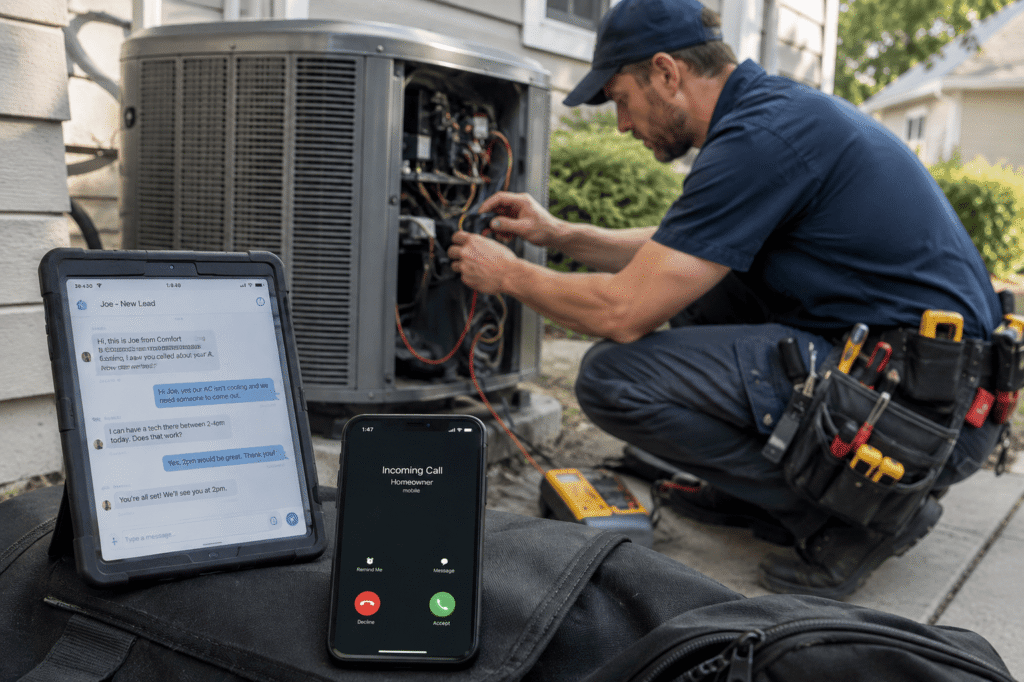
HVAC companies are busy by nature.
Technicians are driving.
Crews are installing equipment.
Dispatchers are coordinating jobs.
Office staff may already be helping another customer.
Your team cannot always answer every call immediately.
The problem is not simply that a call was missed.
The problem is what happens next.
A well-designed missed-call recovery workflow can help keep that opportunity active by triggering an appropriate follow-up process, collecting basic information, and routing the lead to the right person.
That could look like:
Missed Call → Immediate Acknowledgement → Service Need → Urgency → Location → Human Follow-Up → Booking
The exact workflow should depend on your business, phone system, consent requirements, and existing process.
I do not believe every HVAC business needs the same automation template.
Your system should be built around the way your team actually works.
2. Speed Matters When the Customer Is Still Looking
When a homeowner needs HVAC service, the request may be time-sensitive.
They may already be comparing multiple contractors.
That means a response several hours later can have very different value from a response while the prospect is actively searching.
Your first interaction does not necessarily need to sell the entire service.
It needs to keep the conversation moving.
A simple first step may be:
“Thanks for reaching out. We received your request. What type of HVAC service do you need?”
Then the workflow can collect useful information and move the opportunity to the appropriate human team member.
This is one reason I describe my approach as lead conversion, rather than simply “AI automation.”
The objective is the business outcome, not the tool.
3. HVAC Lead Qualification Saves Your Team Time
Not every inquiry is equally ready to book.
A useful lead management system can collect basic information before the next human step.
For example:
What service do you need?
Repair, maintenance, installation, replacement, or another request?
How urgent is it?
Is the customer dealing with no cooling, no heat, a leak, or a routine request?
Where are you located?
Does the customer fall within the company’s service area?
When would you like service?
What appointment window makes sense?
The goal is not to create a 20-question interrogation.
The goal is to give your team enough context to make the next interaction more useful.
4. Your Follow-Up Process Should Not Depend on Memory
One of the most common problems in lead management is not lack of effort.
It is inconsistency.
A prospect receives an estimate.
They say they need to think about it.
Someone promises to follow up.
Then the day gets busy.
The next day becomes another busy day.
Eventually, the lead goes cold.
A structured HVAC lead follow-up workflow can create reminders and communication steps so that promising opportunities are not dependent on someone’s memory.
That does not mean sending endless automated messages.
Good follow-up should be relevant, respectful, and designed around the customer’s stage in the buying process.
5. After-Hours HVAC Leads Need a Clear Next Step
People do not always search for HVAC services during office hours.
A form may arrive late at night.
A homeowner may call on a weekend.
Someone may request emergency service when your normal office team is unavailable.
Instead of letting those leads sit untouched until morning, a business can design an after-hours process that acknowledges the inquiry, gathers useful information, and creates a clear handoff.
For urgent situations, human escalation should remain part of the workflow.
Automation should support the team—not pretend to be the team.
That principle is central to how I design these systems.
AI Can Help HVAC Companies, But the Workflow Comes First
There is a temptation in 2026 to start with the AI tool.
I recommend doing the opposite.
Start with the business problem.
Then decide where automation can help.
For an HVAC company, AI and automation may support:
Lead capture
Automatically organize incoming inquiries from forms, calls, or campaigns.
Lead qualification
Collect and organize basic customer information.
Missed-call recovery
Create a structured response process after an unanswered call.
Lead follow-up
Keep appropriate prospects moving through the next step.
Appointment booking
Connect qualified opportunities to the available scheduling process.
CRM organization
Keep lead status visible so the team knows what happened.
Reporting
Track useful measures such as response time, qualified leads, appointments, and recovered opportunities.
But AI is not the strategy.
The workflow is the strategy.
AI is simply one component that can support it.
A Practical HVAC Lead Management Workflow
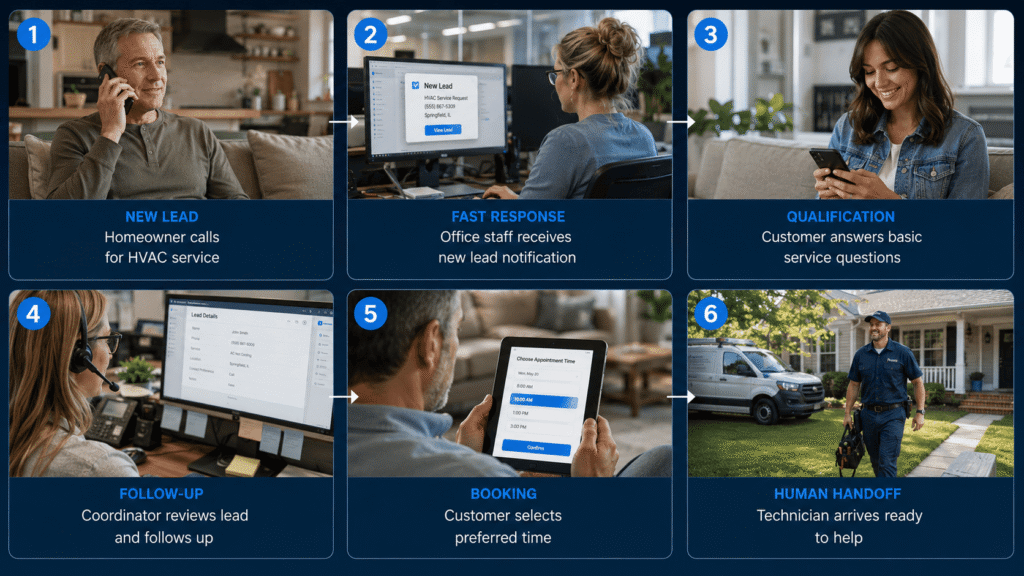
Here is the type of journey I build around an existing HVAC operation:
Step 1 — Capture
A new inquiry arrives from a phone call, website form, ad, or another channel.
Step 2 — Respond
The system helps acknowledge the inquiry while the customer’s attention is still active.
Step 3 — Qualify
Collect the information needed to understand the opportunity.
Step 4 — Follow Up
Create an appropriate next step when the customer does not immediately book.
Step 5 — Handoff
Move qualified opportunities to the person responsible for the next human interaction.
Step 6 — Book
Help the customer reach the appropriate appointment process.
Step 7 — Track
Keep the status visible so the business knows what happened.
This is the same basic philosophy reflected on my How It Works page: map the existing flow, find the leaks, design the workflow, build and connect it, then refine it over time.
Why I Do Not Start by Selling an “AI Chatbot”
If an HVAC company already receives calls and form submissions but loses opportunities between inquiry and booking, installing a random chatbot may not solve the real problem.
The better questions are:
Where are the leads coming from?
Who responds?
How long does it take?
What happens when nobody answers?
How are leads qualified?
Who owns the follow-up?
How are estimates followed up?
What happens after hours?
Where does the information live?
When an HVAC business understands these questions, technology becomes much easier to choose.
That is how I approach automation.
Who Is Md Borhan?
I’m Md Borhan, an automation strategist and digital marketing professional focused on helping HVAC companies reduce the opportunities they lose between inquiry and booking.
My background combines digital growth, web automation, and technical development. On my website, I currently position my work around AI-powered lead conversion and missed-lead recovery for HVAC companies.
My philosophy is simple:
Do not add tools just because they are popular.
Identify the leak.
Build the workflow around the real process.
Make the system understandable to the team.
Measure what happens.
Then improve it.
That approach is much more useful to a business than simply saying, “We use AI.”
What My HVAC Lead Conversion Service Can Help With
Depending on the business and its current setup, I can help design workflows around:
- Missed-call recovery
- Fast lead response
- Website lead follow-up
- Lead qualification
- Appointment booking
- CRM organization
- After-hours inquiries
- Estimate follow-up
- Lead-status visibility
- Human handoff workflows
You can explore my HVAC automation services to see how these components fit into a broader lead-conversion system.
If you are not sure where your biggest leak is, start with a Free Lead Audit.
You May Not Need More Leads
This is the question I would ask before increasing your advertising budget:
How many of your existing opportunities are actually reaching the booking stage?
If leads are already coming in, your next growth opportunity may not be generating more traffic.
It may be improving what happens after someone responds.
Your company might already have:
A website.
Google Ads.
Meta Ads.
A strong reputation.
A phone system.
A CRM.
A sales team.
But if the lead journey is fragmented, valuable opportunities can still disappear.
That is why I focus on the space between lead generation and booked job.
How to Know Whether HVAC Lead Automation Is Right for You
You may be a strong candidate for an HVAC lead management system if:
- Your team misses calls during busy periods
- Website inquiries sometimes wait too long for a response
- You receive leads after hours
- Follow-up depends heavily on individual staff members
- You use paid advertising but do not have clear lead visibility
- Estimates are sent without a consistent follow-up process
- Your CRM contains opportunities that are not being actively worked
- Your team wants better response consistency without replacing human staff
The right solution depends on your current lead volume, phone setup, CRM, team structure, service area, and customer journey.
That is why I prefer to start with an audit instead of forcing every business into the same software stack.
Start With Your Existing Leads
More traffic is not automatically more growth.
More leads are not automatically more revenue.
The real opportunity is creating a reliable path from:
Inquiry → Response → Qualification → Follow-Up → Booking
When that path becomes clearer, your team can spend less time wondering what happened to a lead and more time working the opportunities that actually matter.
I’m Md Borhan, and I build practical AI-powered lead conversion and missed-lead recovery workflows for HVAC companies.
If you believe your business is generating opportunities that are slipping through the cracks, request a Free Lead Audit.
You may not need more leads.
You may need fewer leaks.
About the Author
Md Borhan is an automation strategist and digital marketing professional specializing in AI-powered lead conversion and missed-lead recovery systems for HVAC companies. He helps businesses improve response, qualification, follow-up, and booking workflows while keeping human teams at the center of the customer experience.