A homeowner needs an air conditioner repaired. They search Google, compare a few HVAC companies, and call the first contractor that looks trustworthy.
But what happens when nobody answers?
Or the call is missed while a technician is on a job?
Or a website form arrives after hours, and nobody responds until the next morning?
Or someone asks for an estimate, receives a quote, and then disappears because there is no consistent follow-up?
For an HVAC company, the problem is not always a lack of leads. Sometimes the bigger problem is what happens after the lead arrives.
That is where HVAC lead conversion becomes important.
I’m Md Borhan, an automation strategist and digital marketing professional focused on helping HVAC companies reduce the opportunities that disappear between inquiry and booking. I build practical lead-conversion and missed-lead recovery systems around the way an HVAC business already operates, not generic automation simply because AI is available.
Your goal should not be to automate everything.
Your goal should be to make sure fewer qualified opportunities disappear.
What Is HVAC Lead Conversion?
HVAC lead conversion is the process of turning an inquiry from a potential customer into a meaningful business opportunity, such as a qualified lead, estimate request, scheduled appointment, or booked job.
A lead can come from several places:
- A phone call
- Google Ads
- Facebook or Instagram advertising
- A website contact or quote form
- An organic Google search
- A referral
- An existing customer
- An after-hours inquiry
Generating those inquiries is only the beginning.
The real business question is:
What happens immediately after the lead arrives?
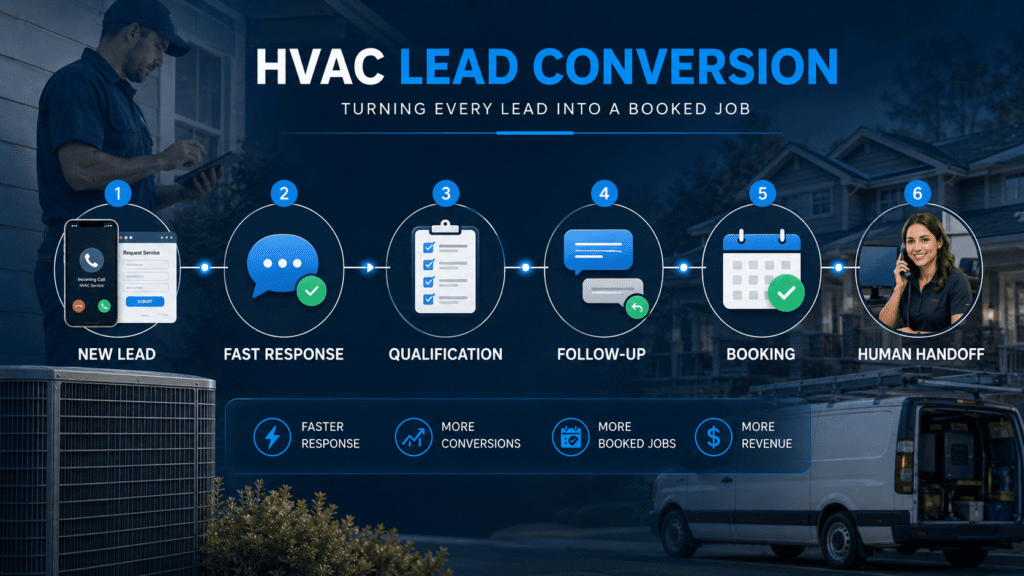
A stronger HVAC lead-conversion system creates a clear path from inquiry to response, qualification, follow-up, and booking.
For example:
New inquiry → Fast response → Qualification → Follow-up → Booking → Human handoff
That is the basic lead journey I focus on building for HVAC businesses.
You can explore the HVAC automation services available through my website to see how these systems can be structured around an existing business process.
Why HVAC Companies Lose Leads After They Generate Them
HVAC businesses often operate in a fast-moving environment.
Technicians are in homes.
Office staff are answering calls.
Dispatchers are coordinating schedules.
New inquiries arrive throughout the day.
Some customers need emergency service. Others want maintenance, installation, repairs, or estimates.
That creates several points where a valuable lead can slow down or disappear.
1. Missed Calls
A homeowner calls because they need help now.
If nobody answers, they may immediately call another contractor.
A missed call does not automatically mean a lost customer, but without a recovery process, the business may never get a second opportunity.
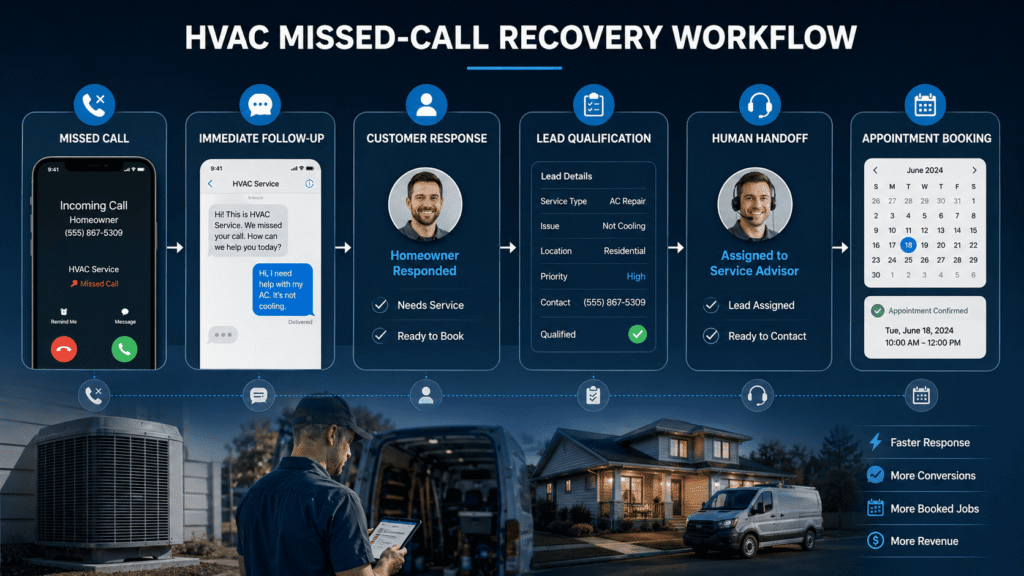
A missed-call recovery workflow can help by acknowledging the caller, asking a small number of relevant questions, and creating a clear path for human follow-up.
2. Slow First Response
A lead that receives no acknowledgement may continue searching.
The longer an interested prospect waits, the greater the chance that attention moves elsewhere.
That is why response speed should be treated as part of lead management, not simply as an administrative task.
My How It Works process starts by mapping how your leads currently arrive and identifying where response delays, missed calls, and follow-up gaps occur.
3. After-Hours Inquiries
HVAC demand does not always follow office hours.
Calls and website inquiries can arrive while the business is closed.
A practical system can acknowledge the inquiry and collect useful information without pretending to replace the human team.
That might include:
Service needed → Urgency → Location → Preferred time → Booking or human handoff
For emergency situations, the workflow should be designed around appropriate human escalation rather than trying to force every interaction through automation.
4. Weak Lead Qualification
Not every lead needs the same response.
A residential AC repair request is different from a maintenance request or complete HVAC installation inquiry.
Useful qualification information can help an HVAC team understand:
- What service is needed
- Whether the request is urgent
- Where the customer is located
- What time works for the customer
- Whether the opportunity is ready for an appointment
The objective is not to interrogate the customer with twenty questions.
The objective is to collect enough information to make the next human step more efficient.
5. Inconsistent Follow-Up
One of the easiest opportunities to overlook is the prospect who did not book immediately.
A homeowner may request an estimate, ask a question, or say they need to check their schedule.
Without a consistent follow-up process, that opportunity may simply disappear.
A better approach is to create a respectful sequence that keeps the conversation organized without overwhelming the customer.
You May Not Need More HVAC Leads
This is one of the most important questions I would ask an HVAC owner:
Before spending more money on lead generation, do you know how efficiently your existing leads are being handled?
Your company may already be paying for:
Google Ads.
Meta Ads.
Lead-generation services.
SEO.
Referral programs.
Website traffic.
But if a meaningful portion of those inquiries are being missed, delayed, poorly qualified, or never followed up with, increasing the lead volume can simply increase the amount of leakage.
Your Free Lead Audit is designed around this exact idea.
Instead of immediately recommending another marketing campaign, the first step is to look at the current journey:
Where does the lead come from?
How quickly is it acknowledged?
What happens when the call is missed?
Who qualifies the inquiry?
What happens after an estimate is sent?
How are after-hours leads handled?
How does a qualified lead reach the booking process?
These questions reveal where automation may actually be useful.
What an HVAC Lead Conversion Workflow Can Automate
Automation should not exist simply because a business can connect an AI tool to a CRM.
It should solve a specific operational problem.
A practical HVAC workflow can include:
Instant Lead Acknowledgement
When a website inquiry arrives, the system can acknowledge the request and provide a clear next step.
Missed-Call Recovery
When an inbound call is missed, a properly configured workflow can help initiate a follow-up process rather than allowing the opportunity to disappear.
Lead Qualification
The system can collect basic information such as service type, urgency, location, and preferred appointment time.
Appointment Booking
Once the lead is sufficiently qualified, the workflow can direct the customer toward an appropriate booking process.
Follow-Up Automation
Prospects who do not immediately book can enter a predefined follow-up sequence.
CRM Visibility
Lead information and status can be organized so the team can understand what happened at each stage.
Human Handoff
This is critical.
Automation should know when to step back.
Your office staff, dispatcher, salesperson, or technician should remain involved where judgment, technical expertise, emergency handling, or customer trust requires a human conversation.
That is why my philosophy is simple:
Automation should support your HVAC team, not replace the human touch.
That philosophy is also reflected throughout my website, where the lead journey is structured around faster response, qualification, follow-up, and human handoff.
A Simple HVAC Lead Conversion Example
Imagine a homeowner searches for an HVAC repair company and submits a website request at 8:30 PM.
Without a structured system:
Lead arrives → Nobody responds → Customer waits → Customer contacts another contractor
With a stronger workflow:
Lead arrives → Fast acknowledgement → Basic qualification → Availability / next-step information → Booking or human handoff
Now consider a missed phone call.
Without recovery:
Missed call → No follow-up → Potential customer disappears
With recovery:
Missed call → Follow-up message → Customer explains the service needed → Qualification → Human team / booking
The technology is not the value by itself.
The value is the better process around the technology.
How I Approach HVAC Automation
I don’t begin by asking, “Which AI tool should we install?”
I begin with the lead flow.
The process is:
Step 1: Map the Existing Lead Flow
Where do leads currently come from?
Which systems receive them?
Who responds?
How are calls, forms, ads, and booking requests handled?
Step 2: Find the Leaks
Look for:
- Missed calls
- Slow first response
- After-hours gaps
- Weak qualification
- Missing follow-up
- Unclear handoffs
- Poor visibility
Step 3: Design the Workflow
The workflow should reflect the company’s service area, staff availability, CRM, calendar, and current operating process.
Step 4: Build and Connect
Only now should automation tools and integrations be selected.
Step 5: Test and Improve
The system should be reviewed based on real interactions, response quality, booking flow, and team feedback.
You can see the full lead journey to understand this approach in more detail.
What About AI?
AI can be extremely useful in lead conversion, but the objective should never be “add AI everywhere.”
AI can help with tasks such as:
- Classifying inquiries
- Extracting information
- Generating initial responses
- Supporting qualification
- Organizing lead information
- Assisting follow-up workflows
However, the workflow still needs clear business rules.
For example, an emergency HVAC situation should not be treated exactly like a routine maintenance inquiry.
Likewise, a qualified homeowner ready to schedule should not be trapped in an endless automated conversation.
AI should make the workflow more useful—not make the customer work harder.
Measure the Right HVAC Lead Conversion Metrics
If you want to know whether your system is working, look beyond the number of leads.
Track:
Leads received
Leads contacted
Average first-response time
Missed calls
Recovered missed calls
Qualified leads
Appointments booked
Appointments completed
Quotes followed up
Closed jobs
Revenue where reliable data is available
This changes the conversation from:
“How much AI are we using?”
to:
“What is happening to the opportunities our marketing is already generating?”
That is a much more useful business question.
When Should an HVAC Company Consider Automation?
You may be a good candidate for lead-conversion automation if your company:
- Already receives a consistent flow of inquiries
- Runs Google or Meta advertising
- Misses calls during busy periods
- Receives leads after hours
- Has a website form but no strong immediate follow-up
- Sends estimates but has inconsistent follow-up
- Uses a CRM but does not have a clear lead workflow
- Has office staff spending significant time on repetitive lead communication
You do not necessarily need a huge software stack.
The appropriate system depends on your current processes, team, lead volume, CRM, phone system, and booking setup.
That is why I recommend an audit before recommending a specific technology stack.
The Bigger Opportunity: Improve the Leads You Already Paid For
HVAC marketing often focuses heavily on acquisition.
And acquisition matters.
But there is another side to growth:
Conversion after acquisition.
If your company spends money getting homeowners to call, fill out a form, or request an estimate, the next challenge is making sure those opportunities receive a dependable path toward a booking.
That is the space where I work.
I’m Md Borhan, and my focus is building practical AI-powered lead conversion and missed-lead recovery systems for HVAC companies.
My approach is not about promising that automation will magically transform a business overnight.
It is about identifying where a lead can disappear, creating a better process around that moment, measuring what happens, and improving the workflow over time.
Start With a Lead Audit
Before increasing your advertising budget, ask a simple question:
Are you converting enough of the opportunities you already receive?
A short audit can help reveal gaps in response, qualification, follow-up, and booking.
I offer a Free Lead Audit for HVAC businesses that want to identify practical lead-conversion opportunities before investing in a larger automation project.
You can also learn more about my HVAC automation services or book a call to discuss your current lead flow.
The goal is simple:
Fewer missed opportunities. Better follow-up. More qualified conversations. A clearer path to booked jobs.
Author: Md Borhan
Role: Automation Strategist & Digital Marketing Professional
Specialization: AI Lead Conversion & Missed Lead Recovery for HVAC Companies